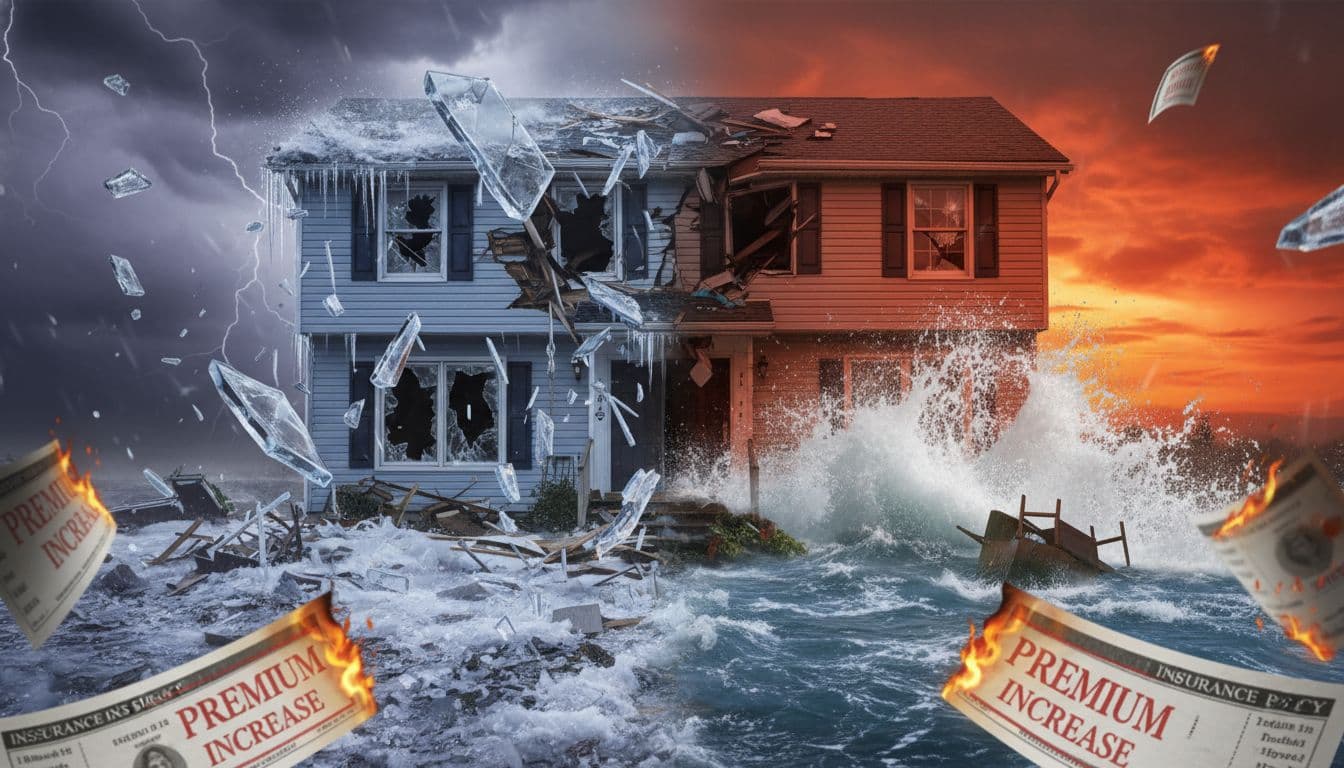
From record hailstorms in Nebraska to burst pipes in Oregon, American homeowners are facing a new reality where weather catastrophes drive insurance costs skyward
The American insurance industry is experiencing something of a perfect storm—quite literally. Between devastating climate disasters and skyrocketing repair costs, 2024 marked a pivotal year that's reshaping how insurers think about risk across the country.
According to the latest data from LexisNexis Risk Solutions, last year saw 27 separate climate-related disasters that each caused over $1 billion in damages. That's not just a worrying statistic—it's a seven-year high that's sending shockwaves through the insurance sector and directly into homeowners' wallets.
The Numbers Tell a Sobering Story
Here's what really stands out: catastrophe claims now represent 42% of all home insurance claims filed in 2024. But the financial impact is even more dramatic. When you look at actual losses, catastrophes accounted for 64% of total losses. In other words, the insurance industry is dealing with fewer claims overall, but the ones tied to major weather events are absolutely massive.
"We're seeing a clear growth trend where catastrophic events are driving overall loss patterns," explains George Hosfield, vice president of home insurance at LexisNexis Risk Solutions. The message is clear: what used to be "once-in-a-lifetime" weather events are becoming disturbingly routine.
Where It Hurts Most: A State-by-State Breakdown
The pain isn't distributed equally across America. Some states are bearing the brunt of climate volatility far more than others.
The Hail Belt Gets Hammered
Nebraska homeowners faced the toughest year of all. The state recorded the highest combined loss costs across all perils in 2024, driven primarily by brutal hailstorms. Even though the total number of hail events nationally dropped to 5,373 (down from 2023), the damage from each storm was severe. Hail loss costs remained 19% above the seven-year average, with nearly two-thirds of these claims classified as catastrophic.
Colorado wasn't far behind, ranking first in loss costs from catastrophic claims alone. The state, along with Nebraska and Kansas, formed a trifecta of hail devastation. Down in Texas, hail became the single most expensive peril for insurers in 2024, surpassing even hurricanes and tornadoes.
Rounding out the states with the highest combined catastrophe and non-catastrophe loss costs were Minnesota, Louisiana, and South Dakota—a diverse group united by their vulnerability to severe weather.
The Lucky Few
On the flip side, Nevada, New Hampshire, West Virginia, Vermont, and Maine enjoyed relatively stable years with the lowest combined loss costs. Geography, it turns out, is increasingly destiny when it comes to insurance affordability.
When Wind and Water Wreak Havoc
Wind claims surged dramatically nationwide in 2024, with severity jumping 23.5% and loss costs skyrocketing by 30.7%. Much of this spike came courtesy of Hurricanes Helene and Milton, which carved paths of destruction that insurers are still tallying up.
But perhaps the most surprising story comes from Oregon, which recorded the highest loss costs due to weather-related water damage. A severe winter storm brought a deadly combination of strong winds and freezing temperatures, causing water pipes to burst across the state. Nationally, 64% of weather-related water claims in 2024 were classified as catastrophic—a staggering figure that underscores how vulnerable modern infrastructure is to extreme cold snaps.
Fire and lightning present a more complex picture. While overall loss costs from these perils actually decreased by 3% nationally, the severity of individual claims increased by 12.2%. Major fires in New York, Connecticut, and New Mexico contributed to this trend, showing that even when fires are less frequent, they're increasingly destructive when they do occur.
The Inflation Double Whammy
Climate disasters alone don't tell the whole story. Insurers are also grappling with sustained inflationary pressures on repair and replacement costs. When a hailstorm damages your roof or hurricane winds tear off your siding, the cost to fix that damage has increased significantly.
Materials are more expensive. Labor is harder to find and costs more. Supply chain disruptions continue to create delays and drive up prices. For insurers trying to price policies accurately, it's like trying to hit a moving target that's accelerating away from them.
This is where advanced data analytics become critical. Hosfield emphasizes that carriers need to leverage sophisticated property data insights—everything from roof condition assessments to water damage risk profiles—to make smarter underwriting decisions. Without these tools, insurers risk either underpricing policies (and losing money on claims) or overpricing them (and losing customers to competitors).
California Takes the Lead on Long-Term Planning
While some states struggle to react to the crisis, California is taking a more proactive approach. The California Department of Insurance, under Commissioner Ricardo Lara, recently announced a groundbreaking Long-Term Solvency Regulation designed to ensure insurers can withstand future shocks.
Given that California represents the largest sub-national insurance market in the world, what happens there tends to influence policy nationwide.
The regulation requires insurance companies to think decades ahead—specifically, to document risks and opportunities projected for 2030, 2040, and 2050 that could impact their underwriting, investments, or operations. This isn't just box-checking; insurers must provide concrete strategies for mitigating climate-related risks, from extreme weather patterns and sea-level rise to changes in water availability and agricultural productivity.
"Regulators worldwide face significant challenges due to rapidly changing climate conditions affecting market stability, affordability, and availability," Commissioner Lara explained when announcing the regulation. The framework also addresses emerging technological risks, particularly around cybersecurity, data quality, and artificial intelligence.
Central to California's approach are "stress tests" that simulate different climate risk scenarios across three time horizons. The goal is to identify vulnerabilities before they become crises and ensure that insurers maintain the financial strength to pay claims even after multiple catastrophic events.
The regulation draws on global best practices, incorporating guidance from the International Association of Insurance Supervisors and UN-led efforts like the Principles for Sustainable Insurance. It's an ambitious attempt to bring long-term climate planning into the regulatory mainstream.
What This Means for Homeowners
For the average American homeowner, these trends translate into a few hard realities:
First, insurance premiums are likely to continue rising, especially in high-risk states. Insurers aren't raising rates out of greed—they're responding to actuarial data showing that payouts are increasing faster than premiums.
Second, coverage may become harder to obtain in certain areas. Some insurers are already pulling back from catastrophe-prone regions or imposing stricter underwriting requirements. Homeowners in states like Nebraska, Colorado, and Texas may find their options narrowing.
Third, the gap between well-maintained properties and neglected ones will widen. Insurers are increasingly using detailed property data to assess risk at an individual level. A home with a newer roof, updated plumbing, and modern weather-resistant features will qualify for better rates than a similar home without those upgrades.
Looking Ahead
The 2024 data paints a picture of an industry at an inflection point. Climate change isn't a future threat—it's a current reality that's fundamentally reshaping the economics of insurance. The question isn't whether the industry will adapt, but how quickly and effectively it can do so.
For insurers, the path forward involves better data, smarter underwriting, and more sophisticated risk modeling. For regulators, it means balancing consumer protection with the need to keep insurers financially sound. And for homeowners, it means accepting that the era of cheap, readily available insurance may be coming to an end, at least in the most vulnerable regions.
The good news is that we're not powerless. Better building codes, climate-resilient infrastructure, and proactive mitigation efforts can all help reduce losses. California's long-term planning approach offers a model for how regulators can encourage forward thinking rather than simply reacting to disasters.
But make no mistake—the transformation of the insurance landscape is well underway, and 2024 may come to be seen as the year the industry truly woke up to the scale of the challenge ahead.
Sources:
- LexisNexis Risk Solutions U.S. Home Trends Report (2025)
- California Department of Insurance regulatory announcements
- Industry analysis from Risk & Insurance and related publications